AI HR Tools for Small Business: What to Expect in 2026
Discover what AI HR tools for small business will look like in 2026. Compare top platforms, key features, and ROI potential for SMBs ready to automate HR.
Introduction
AI HR tools for small businesses are no longer a speculative trend reserved for enterprise budgets. Heading into 2026, SMB founders and operations leads face a genuine inflection point: the gap between what AI HR platforms can deliver for a 20-person team versus a 2,000-person company has narrowed dramatically. Recruitment screening, onboarding workflows, and retention prediction are now accessible at price points that make sense for startups and lean teams across the US, and HR management software for growing teams has become increasingly competitive at the 10-to-100 headcount range.. The real question is no longer whether to adopt, but which capabilities are production-ready and which remain vendor vaporware dressed up in demo slides.
Key Takeaway: Small businesses should prioritize AI recruitment screening, automated onboarding, and payroll automation as deployment-ready capabilities in 2026, while treating predictive retention and sentiment analysis tools with healthy skepticism until they prove ROI at sub-50 headcount scale.

Where AI HR Platforms Stand for SMBs Right Now
The AI-powered employee management landscape in 2026 looks fundamentally different from what vendors were pitching two years ago. Several feature categories have moved from experimental to operationally reliable, while others remain stuck in pilot mode. Understanding that distinction is the difference between a smart investment and a wasted subscription.
Capabilities That Are Ready to Deploy
Three core HR functions have matured enough for small businesses to adopt with confidence. These are not bleeding-edge experiments; they are workflows where AI consistently reduces manual hours and error rates in real production environments.
AI Recruitment Screening: Resume parsing, candidate scoring, and automated shortlisting now handle high-volume applicant pools with accuracy rates that rival dedicated recruiters, particularly for structured roles.
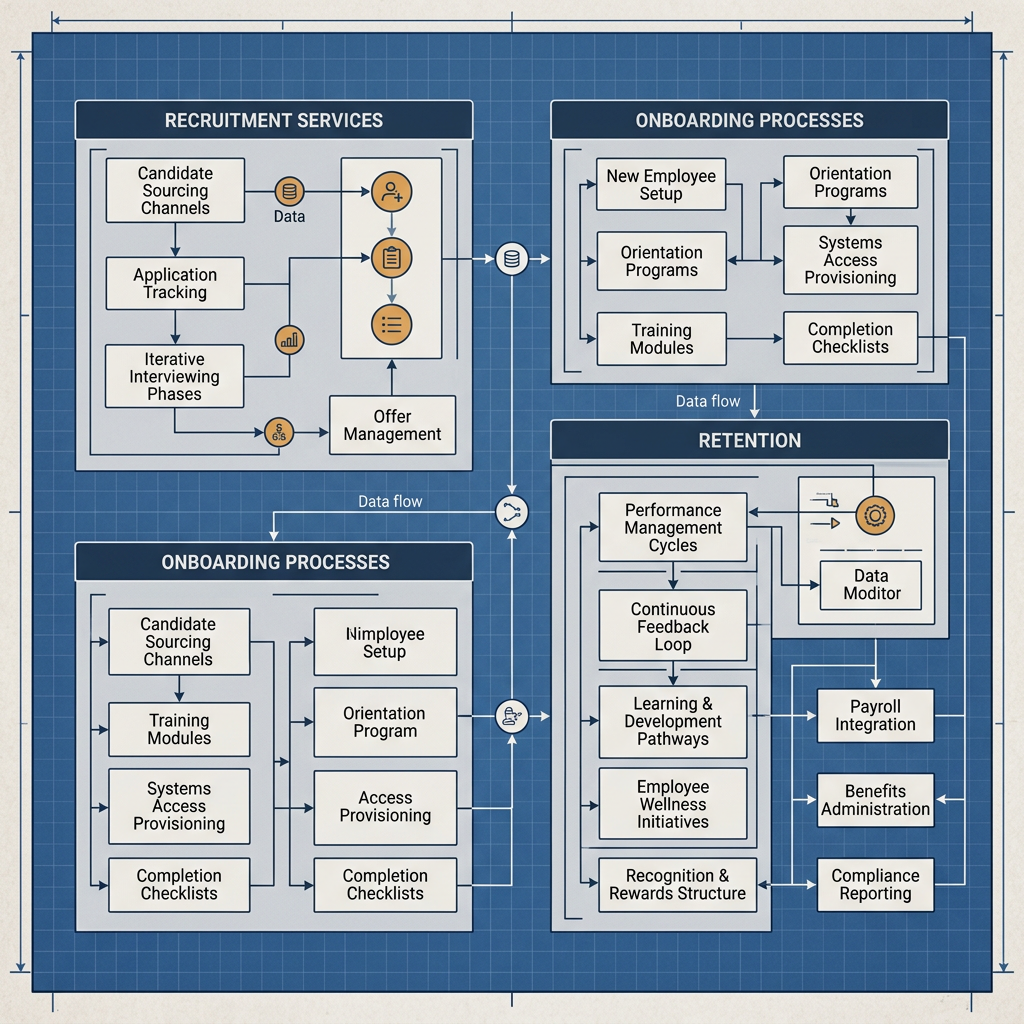
Automated Employee Onboarding: AI-driven onboarding platforms generate personalized task sequences, route compliance documents, and trigger check-in reminders without requiring HR staff to manually chase each new hire through a checklist. Platforms that pair onboarding automation with centralized employee record management deliver the most value here, since records and onboarding tasks live in the same system.
AI Payroll Automation: Payroll software with embedded AI handles tax classification, deduction calculations, and multi-state compliance with fewer manual overrides than legacy systems demand.
Compliance Document Management: AI tools now flag missing I-9s, track certification expirations, and surface regulatory changes relevant to your state, reducing the risk of audit penalties.
Capabilities That Remain Overhyped
Predictive retention modeling and AI-driven sentiment analysis are the two areas where vendor marketing consistently outpaces reality for small businesses. At enterprise scale with thousands of data points, these models can identify attrition patterns. At a 15- to 40-person company, the sample sizes are too small for reliable predictions, and the outputs tend to surface what any attentive manager already knows. Similarly, AI performance management tools that claim to replace structured reviews with continuous algorithmic feedback still produce noisy, context-free recommendations that require significant human interpretation. SMB leaders should evaluate the current state of AI HR readiness before committing budget to these features.

Comparing the Best AI HR Software in 2026
Choosing between AI HR platforms requires looking beyond feature checklists. What matters for a small business is whether a tool delivers value at your headcount, integrates with your existing stack, and prices fairly without locking you into enterprise contracts. The following comparison benchmarks the platforms most frequently evaluated by SMBs heading into 2026.
AI HR Tools Comparison: Features, Pricing, and Fit
This table breaks down the top-rated AI HR solutions for SMBs across the categories that matter most: core automation features, pricing transparency, and minimum viable team size for meaningful ROI.
Platform | Core AI Features | Starting Price (per employee/mo) | Best For | Limitations |
|---|---|---|---|---|
Gusto | AI payroll, tax compliance, basic onboarding automation | $6 | US startups under 50 employees | Limited recruitment screening |
Rippling | Full-lifecycle automation, AI recruitment, device management | $8 | Tech-forward SMBs scaling quickly | Complexity can overwhelm very small teams |
BambooHR | AI-assisted hiring, performance tracking, employee self-service | $7.25 | HR generalists managing 25-150 employees | Predictive analytics still basic |
Deel | Global compliance AI, contractor management, automated onboarding | $5 (contractors) | Distributed and international teams | US-only features lag behind competitors |
Freshteam | AI resume screening, applicant tracking, onboarding workflows | $1.20 | Budget-conscious SMBs focused on hiring | Payroll and compliance modules are thin |
The takeaway here is clear: no single platform dominates every category. Affordable AI HR software for US startups often means choosing a platform that excels in one or two areas that match your most painful bottleneck, whether that is payroll compliance, recruitment volume, or onboarding friction, and accepting trade-offs elsewhere. Rippling offers the broadest feature coverage but introduces operational complexity that a five-person team may not need. Freshteam wins on price but requires supplementary tools for payroll. The right choice depends on which manual process is costing the most hours per week.
ROI Benchmarks: AI HR Platforms vs Traditional Systems
The most common objection from SMB operators is cost justification. When comparing AI HR software to traditional systems, the ROI analysis should center on hours recovered, not feature counts. A typical HR generalist at a 30-person company spends roughly 15 to 20 hours per week on administrative tasks like payroll processing, benefits enrollment, and compliance tracking. AI payroll automation software alone can reclaim 6 to 8 of those hours. When you layer in automated onboarding workflows that enhance effectiveness across the employee lifecycle, the payback period for most affordable AI HR platforms falls between 3 and 5 months for teams above 15 employees.
The comparison shifts further when factoring in error reduction. Manual payroll mistakes carry an average correction cost of $250 to $500 per incident when accounting for staff time and potential penalties. For small businesses operating in multiple US states, AI-driven tax classification alone can prevent thousands in annual compliance exposure. The question of whether AI HR software is worth the investment for SMBs becomes straightforward once you measure it in recovered hours and avoided penalties rather than subscription line items.
What to Watch For: Risks and Practical Guidance
Adopting AI in HR is not without risk, particularly for small businesses that lack dedicated legal or compliance teams. Two areas deserve attention before signing any contract.
Compliance and Bias Risks
AI recruitment tools that screen resumes and score candidates carry documented risks of algorithmic bias. Several US jurisdictions, including New York City and Illinois, already require bias audits for automated employment decision tools. By 2026, federal guidance from the EEOC has further clarified employer liability when AI systems produce discriminatory outcomes, even if the employer did not design the algorithm. Small businesses using AI recruitment tools should demand bias audit documentation from vendors and avoid platforms that treat their scoring models as proprietary black boxes.
TrackRaptor has covered the broader challenge of algorithmic transparency across analytics and tracking systems, and the same principles apply here: if you cannot audit what an AI system is actually doing, you are accepting risk you cannot quantify. For HR specifically, that risk carries legal weight under Title VII and the ADA.
Implementation Priorities for Small Teams
The biggest implementation mistake SMBs make is trying to deploy every AI HR feature at once. A phased approach yields better outcomes. Start with payroll automation and compliance monitoring, where the ROI is most immediate, and the data requirements are lowest. Layer in recruitment screening once your hiring volume justifies it, typically when you are filling more than 5 roles per quarter. Onboarding automation fits naturally as the third phase, triggered by the operational strain of ramping multiple new hires simultaneously.
Platforms like TrackRaptor emphasize the importance of measuring what matters before scaling tooling, and that principle translates directly to HR software adoption. Define your baseline metrics first: time-to-hire, onboarding completion rates, payroll error frequency. Then track improvements against those baselines after each phase of AI deployment. Without that measurement discipline, you are flying blind on whether your small business HR automation investment is actually delivering returns.
Conclusion
The AI HR tools landscape in 2026 offers small businesses genuine operational leverage, but only when adopted with clear-eyed expectations about what works and what does not. Recruitment screening, onboarding automation, and payroll intelligence are ready for production deployment at SMB scale. Predictive retention and sentiment analysis need more maturation before they deliver reliable value below 50 employees. The path forward is phased adoption, rigorous ROI measurement, and vendor accountability on bias and transparency, not a rush to automate everything at once.
Frequently Asked Questions (FAQs)
What AI HR tools should small businesses use in 2026?
Small businesses should prioritize platforms with proven AI payroll automation, recruitment screening, and onboarding workflows, such as Gusto, Rippling, or BambooHR, depending on team size and primary pain points.
Can small businesses afford AI HR tools?
Yes, most AI HR platforms now offer per-employee pricing starting between $1.20 and $8 per month, making them accessible for teams as small as 10 to 15 employees with payback periods of 3 to 5 months.
How does AI recruitment screening work?
AI recruitment screening parses resumes against job requirements, scores candidates on qualification fit, and automatically shortlists top applicants using natural language processing and pattern matching.
Can AI predict employee turnover?
AI can identify turnover patterns at enterprise scale with large datasets, but for small businesses under 50 employees, sample sizes are generally too small for predictions to be meaningfully more accurate than direct manager observation.
Is AI HR software worth the investment for SMBs?
For teams above 15 employees, AI HR software typically pays for itself within a few months through reduced administrative hours, fewer payroll errors, and lower compliance risk exposure.
How does AI handle HR compliance?
AI compliance tools automatically track regulatory changes, flag missing employee documents, monitor certification expirations, and calculate multi-state tax obligations to reduce the risk of audit penalties.
Which AI HR platforms offer the best ROI for SMBs?
Gusto and Freshteam offer the strongest ROI for budget-conscious small teams, while Rippling delivers the highest feature-to-cost value for fast-scaling companies willing to invest in a more comprehensive platform.