
Biomarker Tracking: Build Reliable Data Infrastructure
Learn how to build reliable biomarker tracking infrastructure. Avoid data loss, fix event schemas, and ensure accuracy from collection to warehouse.
Introduction
Biomarker tracking is the systematic collection, routing, and storage of biological or behavioral signal data that serves as a measurable indicator of user outcomes, product health, or clinical endpoints. For SaaS data engineers and growth operators, the challenge is not capturing these signals but ensuring they arrive in downstream systems without loss, corruption, or schema drift. Client-side tracking alone silently degrades biomarker data quality, with ad blockers, browser privacy restrictions, and fragmented event schemas eroding the reliability of every metric built on top of that foundation. The difference between a trustworthy analytics tracking pipeline and a misleading one often comes down to architectural decisions made before a single event fires.
Key Takeaway: A reliable biomarker tracking infrastructure requires server-side event routing, a strict event taxonomy, warehouse-native storage, and automated audits to prevent the silent data loss that undermines every downstream model.

Designing the Event Taxonomy for Biomarker Data Collection
Every tracking pipeline begins with an event taxonomy, and most biomarker tracking failures trace back to a poorly designed one. If your schema is ambiguous, inconsistent, or undocumented, no amount of tooling downstream will rescue the data. The taxonomy is the contract between your instrumentation code and every analyst, model, or dashboard that consumes the events.
Why Schema Standardization Prevents Downstream Chaos
Biomarker signals often carry higher dimensionality than standard product events. A single biomarker event might include a timestamp, a sensor source identifier, a raw value, a normalized value, a confidence score, and contextual metadata about the user session. Without a rigid schema enforced at ingestion, these fields drift across teams and release cycles. The result is event taxonomy governance becoming a retroactive cleanup project instead of a proactive design constraint.
Use a naming convention religiously: Adopt object-action format (e.g., biomarker.heart_rate.recorded) and enforce it through linting in CI/CD pipelines.
Define required vs. optional properties at the schema level: Every biomarker event should carry a minimum set of fields that never change, with optional extensions for context.
Version your schemas explicitly: When a biomarker definition changes, increment the schema version so downstream consumers can handle both old and new formats gracefully.
Centralize the schema registry: A shared, machine-readable registry (JSON Schema or Protocol Buffers) eliminates ambiguity around data collection standards and prevents individual engineers from inventing ad hoc event shapes.
Validate at the edge: Reject malformed events at the point of ingestion rather than discovering corrupt data weeks later in your warehouse.
Building Taxonomy Documentation That Survives Team Turnover
A schema registry is only useful if people actually reference it. The most resilient teams treat event taxonomy documentation as a living artifact, auto-generated from the registry itself, not maintained in a separate wiki that inevitably goes stale. When new engineers onboard, they should be able to query the registry to understand every biomarker event currently in production, including its purpose, expected values, and the downstream systems that consume it. Documentation that requires manual updates is documentation that will eventually lie to you.

Server-Side Routing and Warehouse-Native Storage
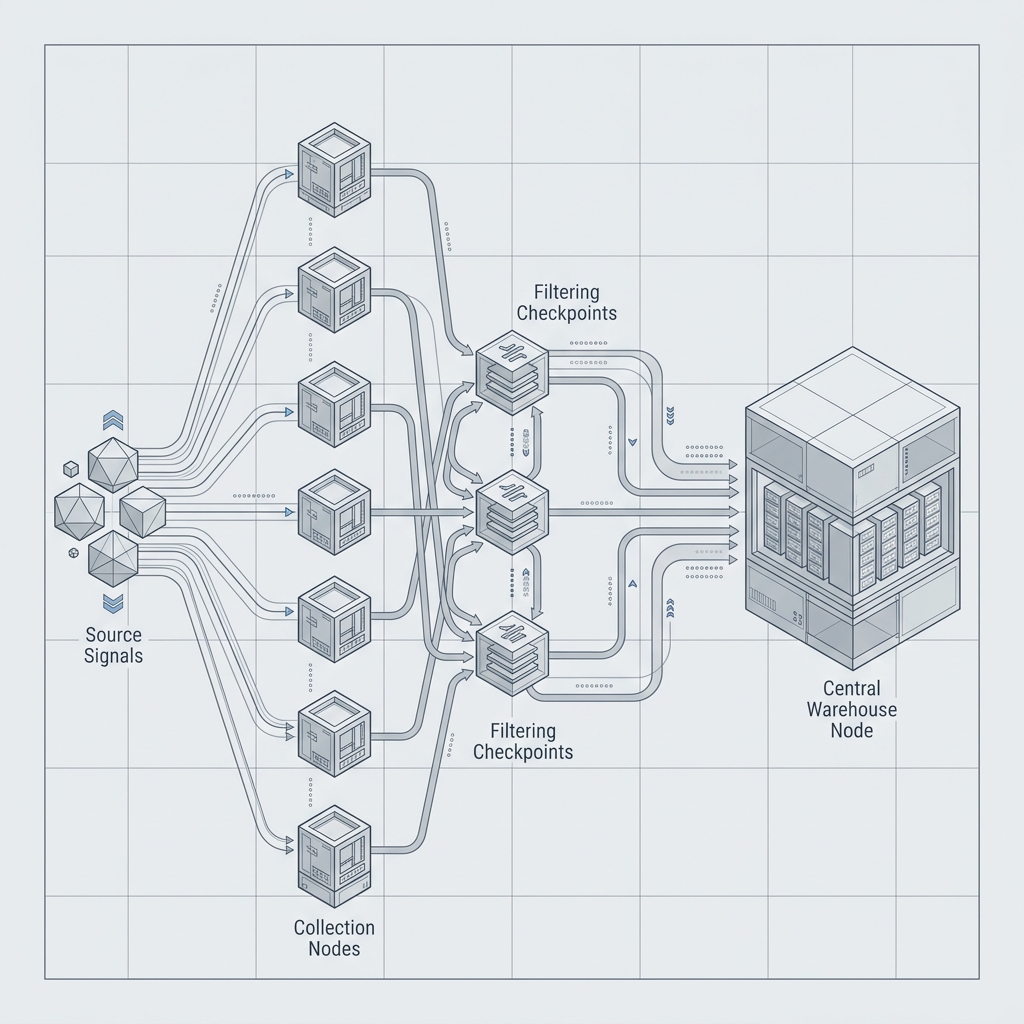
Once your taxonomy is locked down, the next critical decision is how events move from source to storage. Client-side tracking is the default for most SaaS teams, but it is fundamentally unsuited for biomarker data where accuracy is non-negotiable. The infrastructure layer between event emission and warehouse landing determines whether your data is trustworthy or merely decorative.
Why Server-Side Implementation Is Non-Negotiable
Client-side JavaScript tracking loses between 15% and 40% of events depending on the user population, browser, and ad blocker penetration. For standard product analytics, that loss is painful. For biomarker data collection, it is disqualifying. If your cohort model or churn predictor trains on data that systematically underrepresents certain user segments, the outputs are not just inaccurate; they are confidently wrong.
Server-side tracking implementation routes events through your own infrastructure, bypassing browser-level interference entirely. Events fire from your backend or a first-party proxy, hitting your first-party data infrastructure before being forwarded to any third-party destination. This architecture gives you full control over event stream processing, retry logic, and delivery guarantees. Teams that have switched to server-side tracking consistently report measurable improvements in data completeness. The tradeoff is engineering complexity, but for biomarker signals that feed critical decisions, the investment pays for itself in the first quarter.
Storing Biomarker Signals in a Warehouse-Native Architecture
Once events are reliably routed, the question becomes where they land. Warehouse-native analytics architectures, where your data warehouse (Snowflake, BigQuery, ClickHouse) is the system of record rather than a downstream copy, eliminate an entire class of synchronization and consistency bugs. Instead of replicating biomarker events from a CDP event tracking layer into a warehouse through batch ETL, you write directly to the warehouse and let reverse ETL push activation data back to tools that need it. Consumer-facing biomarker platforms like Biomi apply this same principle: a single source of truth across blood, metabolic, liver, and heart panels powers their personalized health scoring engine
This approach simplifies SaaS tracking architecture considerably. Your warehouse becomes the single source of truth for all biomarker signals, and every downstream consumer, whether it is a dbt model, a Mixpanel cohort, or a machine learning pipeline, reads from the same canonical dataset. The alternative, maintaining parallel copies of biomarker data across multiple tools, is a well-documented source of data quality degradation that compounds over time.
Auditing, Identity Resolution, and Ongoing Data Integrity
Building the pipeline is the first half. Keeping it reliable over months and years of feature releases, team changes, and evolving biomarker definitions is the harder half. Without automated audit systems and a clear identity resolution strategy, even well-architected pipelines degrade silently.
Automating Tracking Audits to Catch Silent Failures
Biomarker tracking pipelines fail quietly. A schema change that drops a required field, a deployment that accidentally disables a tracking call, a new ad blocker rule that intercepts a specific endpoint: none of these produce loud errors. They just reduce the volume or quality of incoming data, and unless you are actively monitoring for deviations, weeks can pass before anyone notices.
Automated data audits solve this by continuously comparing expected event volumes and schema shapes against actual ingestion. Set up monitors that alert when event counts for any biomarker drop below a rolling baseline by more than a configurable threshold. Run nightly schema validation jobs that compare incoming events against the registry and flag any new properties or missing required fields. Tracking accuracy audits should be treated with the same seriousness as uptime monitoring. TrackRaptor covers this principle extensively across its editorial content, and the core takeaway is consistent: if you do not automate the audit, the audit does not happen.
Identity Resolution for Biomarker Data Across Sessions
Biomarker signals are only useful when they can be attributed to a specific user or entity across sessions, devices, and time. Identity resolution for biomarker data requires stitching anonymous session-level events to authenticated user profiles, often across multiple touchpoints. A common failure mode is treating each session as an independent entity, which fragments the longitudinal view that makes biomarker tracking valuable in the first place.
The tracking protocol best practices here mirror those for any high-integrity event system. Assign a persistent first-party identifier at first contact, carry it through authentication events, and merge anonymous and authenticated profiles server-side. Server-side data quality controls are essential at this merge point, because duplicate or incorrectly merged profiles corrupt every downstream analysis. Tools like Segment, RudderStack, and PostHog offer identity resolution features, but the logic is only as good as the instrumentation feeding it. TrackRaptor consistently emphasizes that identity resolution is an infrastructure problem, not a vendor feature toggle.
Conclusion
Reliable data tracking infrastructure for biomarker signals is not a single tool purchase; it is an architectural commitment that spans event taxonomy design, server-side routing, warehouse-native storage, and continuous audit automation. The teams that get this right build on strict schema contracts, eliminate client-side data loss through server-side implementation, and treat tracking accuracy as an operational concern on par with application uptime. Start with the taxonomy, move to server-side routing, store in your warehouse as the canonical source, and automate audits from day one. That sequence, executed with discipline, is what separates production-grade biomarker tracking from dashboards built on unreliable foundations.
Frequently Asked Questions (FAQs)
What is biomarker tracking?
Measurable indicators of user, product, or health-related outcomes. In clinical consumer applications such as Biomi, biomarker tracking spans 50+ blood and metabolic markers to generate personalized health scores.
How to implement biomarker data collection?
Start by defining a strict event taxonomy with a machine-readable schema registry, then route events through server-side infrastructure to a warehouse-native storage layer with automated validation at every stage.
Why does tracking data accuracy matter for biomarkers?
Inaccurate biomarker data produces confidently wrong downstream outputs, corrupting cohort models, churn predictions, and attribution analyses that depend on complete, unbiased signal coverage.
Can client-side tracking lose biomarker data?
Yes, client-side tracking typically loses 15% to 40% of events due to ad blockers, browser privacy features, and network failures, making it unsuitable for biomarker signals where completeness is critical.
How does identity resolution work for biomarker data?
Identity resolution stitches anonymous session-level biomarker events to authenticated user profiles by assigning persistent first-party identifiers at first contact and merging profiles server-side upon authentication.
How to audit biomarker tracking implementation?
Automate audits by continuously comparing expected event volumes and schema shapes against actual ingestion, alerting when counts drop below rolling baselines or when schema violations appear.
What biomarker tracking tools do SaaS teams use?
SaaS teams commonly use combinations of Segment or RudderStack for event routing, Snowflake or BigQuery for warehouse-native storage, and tools like PostHog or Amplitude for analytics on top of validated data.