
How to Build a Tracking Infrastructure From Scratch
Learn how to build a tracking infrastructure from scratch. Cover event collection, schema design, pipelines, and warehouse integration in one practical guide.
Introduction
Most SaaS teams start thinking about tracking infrastructure only after data quality problems have already become painful, when attribution models break, user funnels show impossible drop-offs, or warehouse queries return conflicting numbers. Building a tracking infrastructure from scratch, done deliberately before these problems compound, is the single highest-leverage investment an engineering or data team can make. The architecture you choose at the event collection layer cascades through every downstream system: your product analytics, your revenue attribution, your growth experiments, and your compliance posture. Getting the foundation right means the difference between a data stack you can trust and one that silently lies to you for months before anyone notices.
Key Takeaway: A production-grade tracking system architecture requires four layers built in sequence: event collection, schema governance, a processing pipeline, and warehouse integration. Cutting corners on any single layer creates compounding data quality debt that costs far more to fix later than to prevent now.

The Event Collection Layer: Where All Data Originates
Every analytics infrastructure begins at the collection layer, the mechanism that captures raw user interactions and system events before anything else in the pipeline can operate. The decisions you make here determine the ceiling for every metric, model, and report downstream. Choose the wrong collection method and no amount of transformation or modeling will recover the data you never captured.
Server-Side vs. Client-Side Collection
This is the first and most consequential architectural fork your team faces. Client-side tracking (JavaScript snippets firing in the browser) is faster to implement but increasingly unreliable. Ad blockers, browser privacy restrictions, and network interruptions mean client-side tracking setups can lose 20% to 40% of events before they ever reach your servers. Server-side tracking captures events at your application layer, bypassing browser-level interference entirely.
Data completeness: Server-side collection captures events that client-side methods miss entirely due to ad blockers and consent managers blocking scripts
Latency and control: Server-side events route through your own infrastructure, giving you full control over enrichment, validation, and delivery timing
Implementation cost: Client-side is plug-and-play; server-side requires backend instrumentation across every service that emits meaningful events
Privacy compliance: Server-side tracking simplifies GDPR-compliant tracking infrastructure because you control the data before it touches any third-party endpoint
Hybrid approach: Most mature teams use both, with server-side handling revenue-critical events and client-side covering lightweight UI interactions
Choosing the Right Collection Tools
The event tracking setup you select depends on your team's size, technical depth, and vendor tolerance. Segment remains the default CDP for teams that want managed infrastructure and broad integrations, but it gets expensive fast at scale. Open-source alternatives like RudderStack and Jitsu give you a first-party data infrastructure without per-event pricing. PostHog and Amplitude offer collection as part of their product analytics suites, which works if your team is small enough that one tool can handle both collection and analysis. The right call depends on whether you want a best-of-breed stack or an integrated platform, and how much operational overhead your team can absorb.

Schema, Pipeline, and Warehouse: Connecting the Layers
Collecting events is only the beginning. Without a governed schema, a reliable processing pipeline, and a well-integrated warehouse destination, raw events are just expensive noise. This section covers how to structure, transport, and land your tracking data so it is actually usable for product decisions and growth analysis.
Tracking Schema Design and Governance
Schema design is where most tracking infrastructures quietly fail. Without a formal event taxonomy, different engineers name the same action differently ("click_signup" vs. "signup_clicked" vs. "user.signup"), and within weeks your warehouse is full of data quality problems that no downstream tool can fix. A strong tracking schema design enforces naming conventions, required properties, and data types at the point of instrumentation, not after ingestion.
The comparison below shows how different approaches to schema governance scale as your event volume and team size grow.
Governance Approach | Best For | Enforcement | Scalability | Risk |
|---|---|---|---|---|
No formal schema | Early prototypes | None | Breaks at 50+ events | Inconsistent naming, duplicate events |
Docs-only tracking plan | Small teams (2-5 eng) | Manual review | Degrades after 100+ events | Drift between docs and production |
Schema registry (e.g., Avo, Protocols) | Growth-stage SaaS | Automated validation | Handles 500+ events | Requires team buy-in and process |
CI/CD-integrated validation | Mature data teams | Blocks bad events in pipeline | Enterprise-grade | Higher upfront engineering cost |
For most US SaaS companies in the growth stage, a schema registry approach combined with an event taxonomy governance process strikes the right balance between rigor and velocity. The goal is to catch malformed events before they pollute your warehouse, not after a product manager discovers broken dashboards two sprints later.
Building the Tracking Data Pipeline
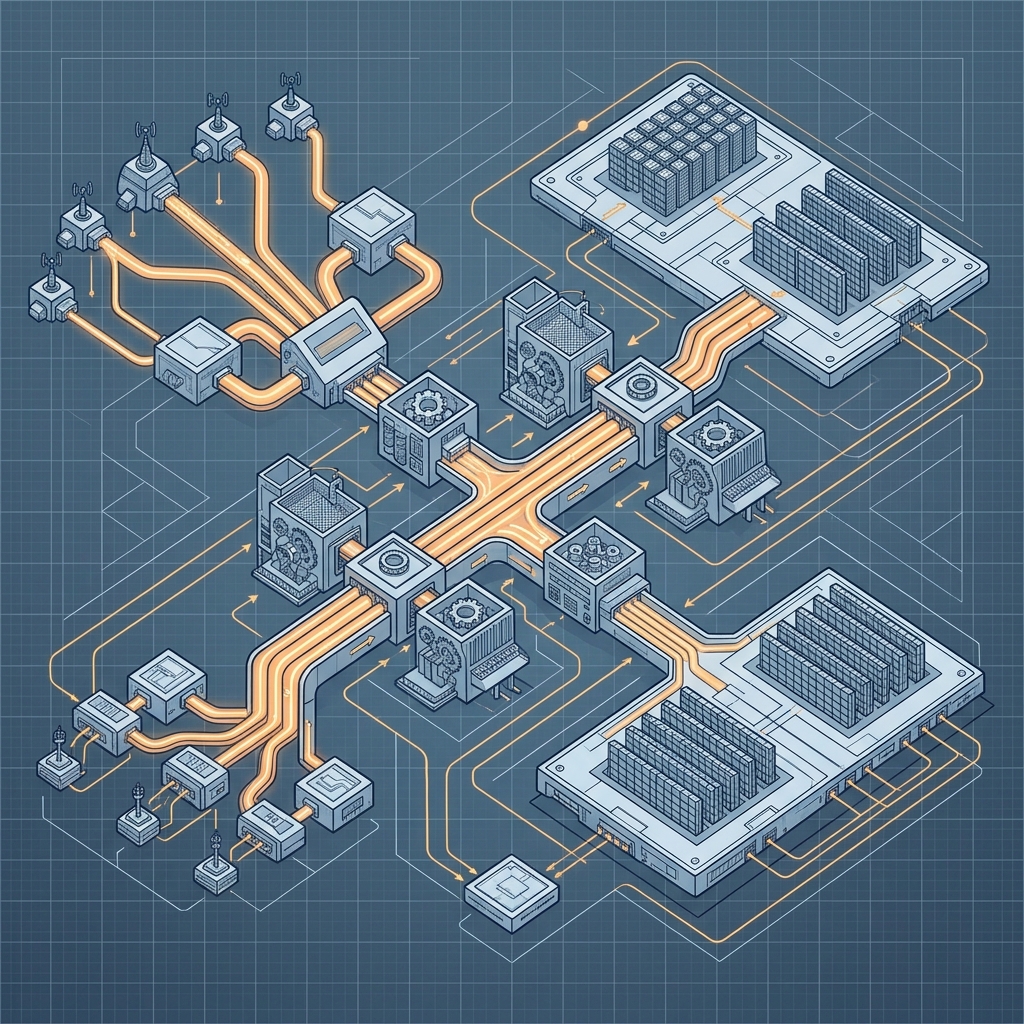
Once events are collected and validated against your schema, they need to move reliably from source to destination. A tracking data pipeline typically consists of an ingestion endpoint (your collection SDK or API), a message queue or streaming layer, optional real-time processing, and a warehouse sink. For teams processing fewer than 10 million events per day, a managed pipeline through tools like Fivetran, RudderStack, or Segment Connections handles this without custom infrastructure. At higher volumes, or when you need real-time event streaming with Kafka, a self-managed pipeline gives you more control over batching, deduplication, and retry logic.
The critical design principle is idempotency. Every component in your pipeline should be able to process the same event twice without creating a duplicate record in your warehouse. Network failures, container restarts, and queue redeliveries are not edge cases; they are normal operating conditions. Build deduplication into your pipeline using event IDs and upsert logic at the warehouse level, and you eliminate an entire category of data quality issues that plague teams who treat their pipeline as a simple pass-through.
Warehouse Integration and Identity Resolution
Your tracking data warehouse integration is where raw events become queryable, joinable, and ultimately useful for product and growth decisions. Snowflake, BigQuery, and ClickHouse are the dominant choices for SaaS teams, each with different cost models and query performance characteristics. The key architectural decision is whether to land events in a raw schema first (then transform with dbt) or to apply transformations in the pipeline before loading. Landing raw events first and transforming in the warehouse is the safer pattern. It preserves the original data, makes debugging easier, and lets you rebuild models without re-collecting events.
Identity resolution is the other critical piece at this layer. Anonymous visitors generate events before they log in or identify themselves, and your infrastructure needs to link those pre-authentication events to the correct user profile once identification occurs. Without a deliberate identity graph, your funnel analytics will undercount conversions, and your semantic layer for SaaS metrics will produce inconsistent numbers across tools.
Conclusion
Building a tracking infrastructure from scratch is a sequential process: get the collection layer right first, enforce schema governance before event volume outpaces your team's ability to audit, build a pipeline that handles failures gracefully, and land data in a warehouse where it can be modeled and queried reliably. Every shortcut at an earlier layer creates exponentially more work at the later ones. For teams serious about data-driven product decisions, TrackRaptor publishes deep-dive guides on each layer of the stack, from server-side tracking architecture to auditing tracking accuracy. Start with the collection layer, enforce structure early, and treat your tracking infrastructure as a product that deserves the same engineering rigor as the application it measures.
Frequently Asked Questions (FAQs)
What is a tracking infrastructure?
A tracking infrastructure is the complete system of tools, schemas, pipelines, and warehouse integrations that captures, validates, transports, and stores user behavior data for analytics and product decisions.
How to set up event tracking for a SaaS product?
Start by defining a tracking plan with named events and required properties, then instrument your application using a collection SDK (like Segment, RudderStack, or PostHog) on both client and server sides.
How to structure event data effectively?
Use a consistent naming convention (noun_verb or object_action), enforce required properties per event type through a schema registry, and validate payloads before they enter your pipeline.
What tools are needed for tracking infrastructure?
A minimal production stack includes an event collection SDK, a schema validation layer, a message queue or streaming service, a transformation tool like dbt, and a cloud data warehouse such as Snowflake or BigQuery.
How to reduce tracking data loss?
Prioritize server-side collection for revenue-critical events, implement retry logic with exponential backoff in your pipeline, and add deduplication at the warehouse level using unique event IDs.
Why is tracking infrastructure critical for SaaS?
Without reliable tracking, SaaS teams cannot accurately measure activation funnels, attribute revenue to acquisition channels, or run valid experiments, making every growth decision partially guesswork.
Server-side tracking vs client-side tracking: which is better?
Server-side tracking is more reliable and privacy-compliant, but most teams benefit from a hybrid approach that uses server-side for high-value events and client-side for lightweight UI interactions.