
Builder Financing vs Bank Mortgage: Which Costs Less?
Compare builder financing vs bank mortgage on rates, costs, and approval. Find out which option saves you more before signing. Make a smarter homebuying decision.
Introduction
Choosing between builder financing and a traditional bank mortgage is one of the most consequential financial decisions a new construction buyer will make, yet the cost differences between these two paths are rarely presented with any transparency. Builder financing options often look attractive on the surface: streamlined approval, bundled incentives, and a single point of contact through the builder's preferred lender a structure new construction buyers in Southern California encounter constantly. The reality is that convenience frequently comes at a premium, hidden inside inflated interest rates, restricted closing cost structures, and prepayment penalties that limit future flexibility. In active new construction markets like Texas and California, buyers who default to the builder's offer without running the numbers against a conventional mortgage often leave tens of thousands of dollars on the table over the life of their loan.
Key Takeaway: Builder financing is designed for the builder's benefit first; comparing it against independent bank mortgage quotes on rate, fees, and long-term flexibility typically reveals that traditional mortgages cost less for most qualified buyers.
Understanding How Builder Financing Works
Builder financing is not a distinct loan product. It is a conventional or sometimes FHA-backed mortgage originated through a lender the builder has a business relationship with, often a subsidiary or captive lending arm. The builder steers buyers toward this lender by offering incentives like closing cost credits, rate buydowns, or upgrades, but those incentives are funded by margins already built into the home's sale price. Understanding this structure is the first step toward making an informed comparison with an independent bank mortgage.
The Incentive Trap in Builder Mortgage Rates
Builders frequently advertise below-market rates or substantial closing cost assistance, but these offers come with conditions that increase total cost. A rate buydown to 5.5% sounds appealing until you realize the builder inflated the purchase price by $15,000 to fund it, or the builder financing structure locks you into a specific loan program with limited flexibility. Here is what to watch for:
Inflated base price: Builders often pad the home price to cover the cost of financing incentives, meaning you finance the "discount" itself a dynamic explained in detail in this guide to how builder incentives are structured for buyers
Mandatory lender use: Incentives typically evaporate if you choose an outside lender, creating artificial pressure to stay with the builder's preferred option
Temporary buydowns: Many advertised rates are 2-1 or 3-2-1 buydowns that reset to a higher permanent rate after the initial period expires
Restricted loan products: Builder lenders may offer fewer program types, limiting access to adjustable-rate options or portfolio products that could save money
What Bank Mortgages Offer Differently
A traditional bank mortgage originates through an independent institution, credit union, or mortgage broker with no financial relationship to the builder. This independence means the lender's revenue comes solely from the loan itself, not from a bundled deal with the developer. The result is typically more competitive rates, broader product selection, and closing cost transparency, much like how first-party data collection gives SaaS teams independent, unbiased signal ownership rather than relying on a vendor-controlled data bundle. Buyers who shop independently also gain leverage to negotiate the purchase price separately from the financing terms, which is a structural advantage that bundled financing deliberately eliminates, the same reason multi-touch attribution models exist to break vendor-controlled single-source credit assignment.

Comparing the True Cost: Builder Financing vs Traditional Mortgage
The only reliable way to compare these two paths is to evaluate them across the same dimensions: interest rate, closing costs, down payment requirements, and long-term cost of the loan. Marketing language from builders obscures these comparisons by design. Breaking each dimension down individually reveals where the real cost differences live.
Side-by-Side Cost Breakdown
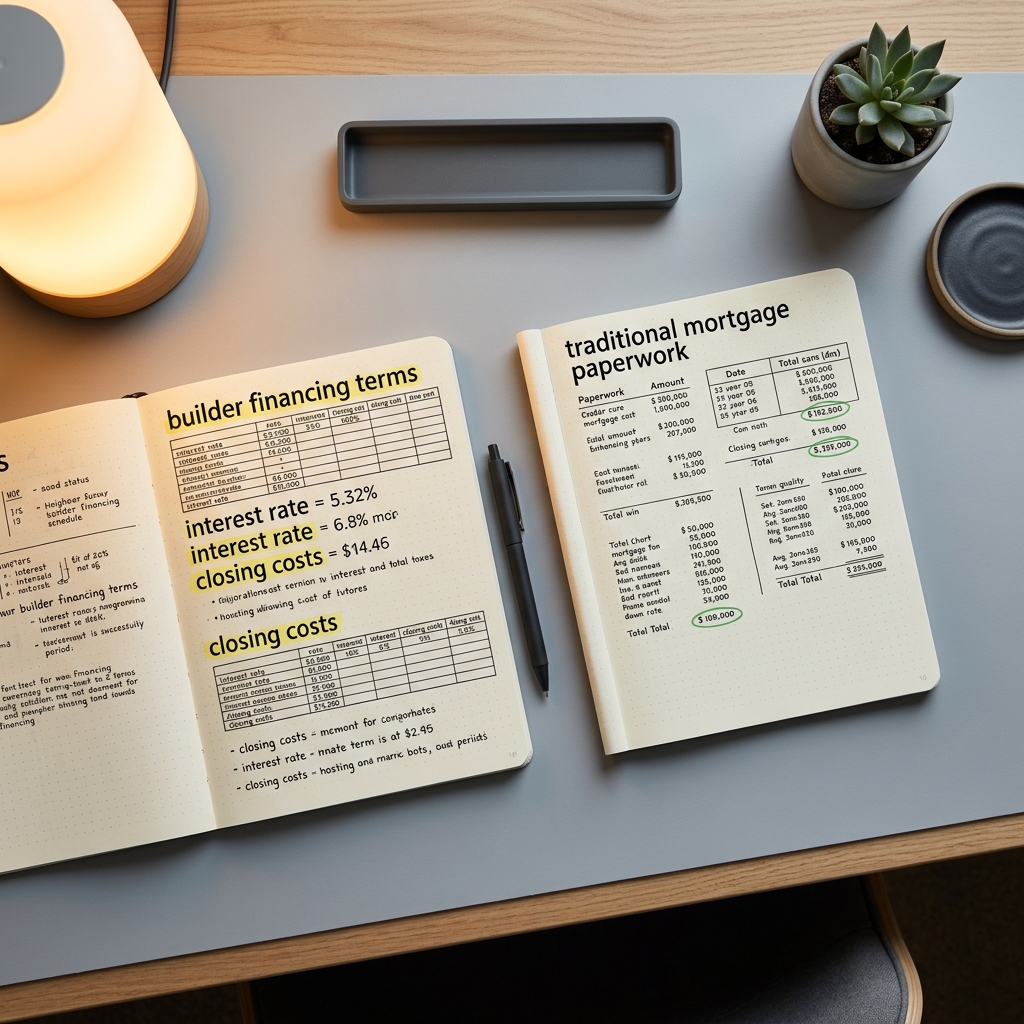
The following table compares builder financing vs bank mortgage across the cost categories that matter most to buyers evaluating a new construction purchase in the $400,000 to $600,000 range, which is common in both Texas and California markets.
Cost Dimension | Builder Financing | Bank Mortgage |
|---|---|---|
Interest Rate (30-yr fixed) | Often 0.25% to 0.75% higher than market; temporary buydowns mask true rate | Market rate; easier to lock competitive rate through rate shopping |
Closing Costs | Builder may offer credits, but total fees can be higher due to affiliated service providers | Typically 2% to 5% of loan amount; fully transparent via Loan Estimate |
Down Payment | May accept as low as 3% to 5%; flexibility varies by builder lender | 3% to 20% depending on loan type (conventional, FHA, VA) |
Prepayment Penalties | More common with captive lenders; restricts refinancing timeline | Rare on standard conventional loans; check loan terms explicitly |
Total 30-Year Cost (on $450K loan) | $30,000 to $55,000+ more due to rate differential and embedded costs | Lower when rate is shopped and closing costs are negotiated independently |
The critical takeaway is that builder financing closing costs and rate premiums compound over the loan's life. A 0.50% rate difference on a $450,000 loan costs roughly $48,000 in additional interest over 30 years. Even generous closing cost credits from the builder rarely offset that long-term expense, especially when those credits are funded by an inflated purchase price. Buyers evaluating construction financing should always request a Loan Estimate from at least two independent lenders before committing to the closing cost structures presented by the builder's lending arm.
Approval Process and Flexibility
Builder lenders market speed and simplicity. In many cases, they can pre-approve buyers within 24 to 48 hours because they control both the underwriting and the property pipeline. This speed is real, but it comes at the cost of negotiating leverage. When the builder, the lender, and sometimes even the title company are all affiliated entities, the buyer has no independent advocate in the transaction, similar to how conversion tracking without independent validation creates blind spots when a single system controls both the data and the decisions. Traditional bank mortgages require more legwork, including appraisals from independent assessors and standard underwriting timelines of 30 to 45 days, but this process protects the buyer by introducing third-party checks on the financing channel decisions being made.
Builder financing in Texas and California carries additional considerations. Texas restricts certain prepayment penalty structures on residential loans, which can work in a buyer's favor, but buyers must verify whether the builder's lender is originating a Texas-compliant loan or routing through an out-of-state entity. California's consumer protection framework through the DFPI adds disclosure requirements, yet captive builder lenders sometimes meet only the minimum standard. In both states, buyers who shop independently gain access to state-specific programs and protections that builder lenders may not surface voluntarily.

Conclusion
Builder financing vs conventional mortgage is not a convenience decision; it is a cost decision with five- and six-figure implications over the life of a loan. The data consistently favors independent bank mortgages for buyers who have the credit profile to qualify and the patience to shop rates. Builders design their financing packages to close deals efficiently, not to minimize the buyer's total cost. For buyers navigating new construction in competitive markets, resources like TrackRaptor provide analytical frameworks for evaluating complex financial decisions with the kind of rigor this choice demands. The smartest move is to get a builder financing quote, then shop it against at least two independent lenders before signing anything.
Frequently Asked Questions (FAQs)
What is the difference between builder financing and bank mortgage?
Builder financing is a mortgage originated through the builder's affiliated or captive lender as part of a bundled purchase deal, while a bank mortgage comes from an independent institution with no financial relationship to the builder, giving buyers more rate shopping leverage and product flexibility.
Is builder financing more expensive than a bank mortgage?
In most cases, yes, because builder financing interest rates tend to run 0.25% to 0.75% higher than independently sourced bank rates, and incentive credits are often offset by inflated purchase prices.
How does builder financing work?
The builder directs buyers to a preferred lender (often a subsidiary), offers incentives like closing cost credits or rate buydowns contingent on using that lender, and bundles the financing into the purchase contract as a package deal.
Can you refinance builder financing?
Yes, but some builder loans include prepayment penalties that make refinancing costly during the first 2 to 5 years, so buyers should verify prepayment terms before closing.
What credit score is needed for builder financing?
Most builder lenders require a minimum credit score of 620 for conventional programs and 580 for FHA-backed loans, though requirements vary by builder and lending partner.
Is builder financing available in Texas?
Builder financing is widely available in Texas, where new construction activity is among the highest in the country, but buyers should confirm the loan complies with Texas-specific residential lending statutes.
What are the best builder financing alternatives in California?
California buyers should compare quotes from local credit unions, independent mortgage brokers, and online lenders that offer competitive conventional or FHA loan products, as these typically undercut builder financing on both rate and total closing costs.