
Composable CDP Architecture: Build vs Buy for SaaS Teams
Should your SaaS team build a composable CDP or buy a traditional one? Explore the architecture trade-offs, costs, and decision framework that matters.
Introduction
The composable CDP architecture movement is forcing SaaS data teams to confront a question that used to have a simple answer: Do you buy a customer data platform or build one yourself? Traditional CDPs like Segment and mParticle offered convenience at the cost of data ownership, vendor lock-in, and escalating contracts that scale with your event volume. Now, warehouse-native CDPs let engineering teams assemble their own customer data infrastructure on top of Snowflake, BigQuery, or Databricks using tools they already know. The trade-offs between these two paths are not theoretical; they directly affect engineering velocity, activation latency, and whether your data team spends its time building features or managing middleware.

Understanding the Two Architectures
Before evaluating cost or complexity, it is worth grounding the conversation in what these two approaches actually look like under the hood. A bundled CDP ingests, stores, models, and activates customer data within its own platform. A composable stack separates those responsibilities across first-party data infrastructure components you control, with your data warehouse as the single source of truth.
How Bundled CDPs Handle the Pipeline
A traditional CDP like Segment or mParticle collects event data via SDKs, resolves identities in its own graph, builds audience segments in its UI, and pushes those segments to downstream tools. This is convenient for teams with limited engineering resources, but it creates several structural constraints that compound as your SaaS product matures.
Data residency: Customer data lives in the vendor's environment, meaning your warehouse gets a copy rather than being the source of truth.
Schema rigidity: The vendor's data model dictates how events and user properties are structured, limiting flexibility for custom product analytics.
Pricing pressure: Costs scale with monthly tracked users or event volume, which means a growing SaaS product faces a growing bill regardless of how much value the CDP delivers.
Activation bottleneck: Building new audience segments or modifying sync logic often requires navigating the vendor's UI rather than writing SQL that your team already understands.
How a Composable Stack Distributes Responsibility
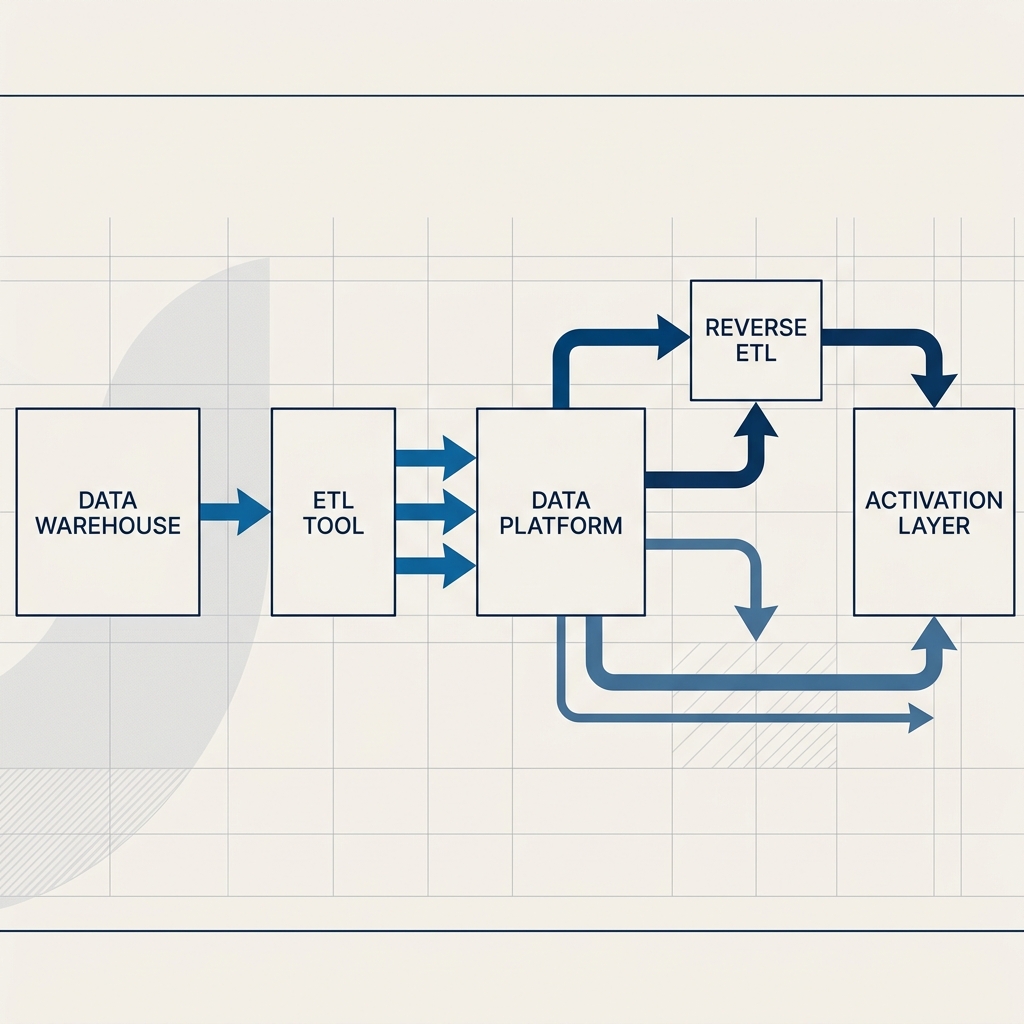
In a composable model, the warehouse (Snowflake, BigQuery, or Databricks) holds all raw and modeled customer data. Transformation happens in DBT, where your team defines the DBT semantic layer and business logic that determines what a "qualified lead" or "churning account" looks like. Reverse ETL tools like Census or Hightouch then sync those modeled tables to downstream tools: your CRM, ad platforms, email systems, and product analytics.
This approach gives data engineers full control over schema design, identity resolution logic, and activation cadence. The trade-off is that you are responsible for building and maintaining each layer of the stack rather than relying on a vendor to abstract it away. That maintenance burden is the crux of the build-vs-buy decision, and it varies significantly depending on team size and data maturity.
Evaluating the Trade-offs That Actually Matter
Generic comparisons of build vs buy tend to focus on headline cost and "time to value" without acknowledging the nuanced factors that determine real ROI for a specific team. For SaaS companies operating within a modern data stack, the decision hinges on five capabilities: cost structure, identity resolution, warehouse activation speed, maintenance overhead, and long-term flexibility.
Cost, Identity Resolution, and Activation Speed
On cost, composable wins for most mid-to-large SaaS teams. A Snowflake CDP setup with dbt and a reverse ETL tool typically costs a fraction of a bundled CDP contract once you pass 50,000 monthly tracked users. The reverse ETL layer (Census, Hightouch, or GrowthLoop) usually runs $500 to $2,000 per month at moderate sync volumes, compared to $12,000+ annually for a mid-tier Segment workspace. The warehouse compute cost exists either way because most SaaS teams already run analytical workloads there.
Identity resolution is where the comparison gets more interesting. Bundled CDPs ship with deterministic and probabilistic identity graphs that work out of the box. In a composable stack, your data engineers build identity stitching logic in SQL or dbt, joining anonymous sessions with authenticated user profiles across devices. This is entirely achievable for teams with strong data engineering talent, but it is not trivial. If your product has complex multi-device or multi-account journeys, evaluate whether your team can match the resolution quality of a dedicated CDP architecture before committing to composable.
Activation speed matters when growth teams need to move fast. In a bundled CDP, creating a new segment and syncing it to an ad platform can happen in minutes through the UI. In a composable setup, it means writing a dbt model, running it against the warehouse, and configuring a sync in your reverse ETL tool. That loop can be streamlined with good CI/CD, but it is inherently slower for ad-hoc requests from non-technical stakeholders.
Maintenance Burden and Long-Term Flexibility
The maintenance argument is the one most build-vs-buy analyses understate. A composable CDP is not a project you ship once. It is infrastructure you maintain: dbt models need updating when your event taxonomy changes, sync jobs need monitoring for failures, and schema migrations require coordination across multiple tools. For a team of three data engineers supporting a Series B SaaS product, that overhead can consume 20 to 30 percent of available engineering hours in the first year. TrackRaptor has covered this dynamic extensively, noting that teams often underestimate the ongoing cost of orchestrating real-time event streaming alongside batch-based warehouse models.
Long-term flexibility is where composable stacks earn their keep. When your data lives in your warehouse and your logic lives in dbt, swapping out any single component (your reverse ETL tool, your analytics layer, even your warehouse) does not require re-architecting everything. Bundled CDPs create deep integration dependencies that make migration painful. For SaaS teams thinking on a three-to-five-year horizon, that portability often justifies the higher upfront investment in building. Tools like Hightouch's composable CDP solution specifically target this flexibility gap by treating the warehouse as the canonical data layer.

Conclusion
The build-vs-buy decision for a customer data platform is not about which approach is universally better. It is about matching architecture to team capability, data maturity, and product complexity. Composable CDPs are the right call for SaaS teams with strong data engineering resources, an existing warehouse investment, and a need for schema flexibility and data democratization. Bundled CDPs still make sense for early-stage teams that need fast time-to-value without dedicating engineering headcount to infrastructure. Build the mental model, run the numbers on your specific event volume and tool costs, and let your first-party data strategy drive the decision rather than vendor marketing.
Explore TrackRaptor's deep-dive library on warehouse-native analytics, tracking infrastructure, and SaaS data architecture to sharpen your team's evaluation process.
Frequently Asked Questions (FAQs)
How do warehouse-native CDPs work?
Warehouse-native CDPs use your existing data warehouse as the central storage and modeling layer, then activate customer segments through reverse ETL syncs to downstream tools instead of duplicating data into a separate platform.
What are the benefits of composable CDPs?
Composable CDPs offer greater data ownership, schema flexibility, lower long-term costs at scale, and the ability to swap individual components without re-architecting your entire customer data infrastructure.
Can Snowflake replace a CDP?
Snowflake can serve as the storage and compute foundation of a CDP when paired with transformation tools like dbt and activation tools like Census or Hightouch, but it does not natively handle identity resolution or audience syncing on its own.
Can you use dbt for CDP functionality?
Teams use dbt to define transformation logic, build user profiles, score accounts, and create audience segments inside the warehouse, effectively replacing the modeling layer of a traditional CDP with version-controlled SQL.
What is the difference between composable and bundled CDPs?
A bundled CDP handles data collection, storage, identity resolution, and activation within a single vendor platform, while a composable CDP distributes those responsibilities across best-of-breed tools anchored by your own data warehouse.