
Event Data Pipeline Architecture: From Collection to Warehouse
Learn how to architect an event data pipeline from collection to warehouse. Covers validation, enrichment, and routing for reliable SaaS analytics at scale.
Introduction
Every SaaS analytics stack depends on a reliable event data pipeline, yet most teams only think about pipeline architecture after dashboards start returning nonsensical numbers. The gap between firing a raw user event and querying it cleanly in Snowflake or BigQuery is deceptively wide, filled with validation gates, enrichment logic, routing decisions, and schema enforcement that can each silently corrupt data if misconfigured. Event tracking implementation that stops at "we added Segment" misses the structural engineering required to move data at scale without loss or duplication. Understanding each stage of the pipeline, from collection through warehouse loading, is what separates teams that trust their metrics from teams that spend every Monday reconciling conflicting reports.

The Collection Layer: Where Events Are Born
Event data collection is the entry point of the entire pipeline, and it is also where the most damage happens. A malformed event at the source propagates through every downstream system, creating phantom metrics that are nearly impossible to diagnose weeks later. Getting collection right means choosing the correct transport mechanism, enforcing structure at the point of capture, and designing for resilience when networks fail.
Client-Side vs. Server-Side Instrumentation
The first architectural decision is where events originate. Client-side SDKs (JavaScript snippets in the browser, mobile SDKs) are fast to deploy but vulnerable to ad blockers, browser privacy restrictions, and script-loading failures that can silently drop 20-30% of events. Server-side tracking shifts event capture to your backend, which eliminates most data loss vectors but requires deeper engineering investment.
Client-side pros: Quick setup, access to browser-level context like referrer and viewport, and minimal backend changes required
Server-side pros: Higher data reliability, immunity to ad blockers, and full control over payload structure before it leaves your infrastructure
Hybrid approach: Many production systems use client-side for behavioral UI events and server-side for transactional events like purchases, subscription changes, and API calls
Transport protocol: HTTP POST remains standard, but teams running high-throughput systems should evaluate direct-to-Kafka producers to avoid intermediate API bottlenecks
Designing Events That Survive the Pipeline
A well-structured event carries a consistent schema from the moment it fires. That means every event includes a unique event ID (for deduplication downstream), a server-generated timestamp (never trust client clocks), a user or anonymous identifier, and a properties object that conforms to a predefined event taxonomy. Teams that skip schema enforcement at collection spend exponentially more time debugging broken funnels later. The goal is to treat each event as a self-contained record that any downstream consumer can parse independently without needing context from other events in the same session.

Validation, Enrichment, and Routing: The Middle of the Pipeline
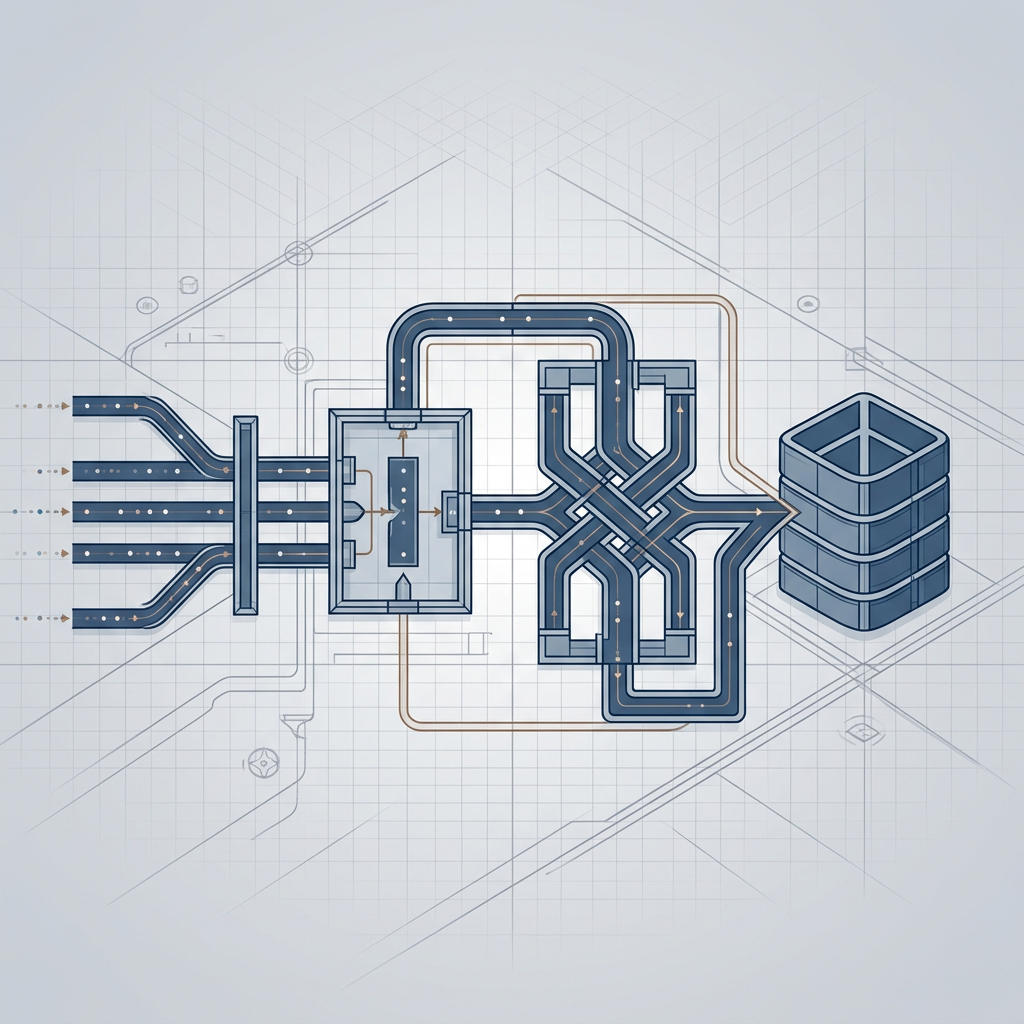
Once events leave the collection layer, they enter the processing tier where the real engineering complexity lives. This middle section is where event validation, data enrichment, and routing decisions determine whether clean, trustworthy records reach your warehouse or whether garbage data silently accumulates in your tables. Most pipeline failures trace back to weak or nonexistent logic at this stage.
Event Validation and Schema Enforcement
Event validation is the quality gate that prevents malformed data from reaching storage. At minimum, every event should be checked against a JSON Schema or Protocol Buffer definition that enforces required fields, data types, and allowed values. When an event fails validation, the pipeline must decide: reject it, route it to a dead-letter queue for inspection, or flag it and pass it through. The right choice depends on your tolerance for data loss versus data pollution.
Production-grade systems typically implement a two-tier validation strategy. The first tier runs synchronously at ingestion, checking structural requirements like "does this event have a user_id and a timestamp?" The second tier runs asynchronously, applying business-logic checks like "is this revenue value within a plausible range?" or "does this plan_name match a known product SKU?" Automated data audits at this stage catch drift before it compounds. Teams using tools like Segment can leverage Protocols for schema enforcement, while custom pipelines often use Apache Avro registries or internal validation microservices. The key principle is the same regardless of tooling: never let an event schema change in production without validation catching it first.
Enrichment and Routing to Downstream Consumers
After validation, events pass through an enrichment layer that attaches contextual data not available at the point of capture. Common enrichment steps include resolving anonymous IDs to known user profiles through identity resolution, appending geo-location data derived from IP addresses, and decorating events with account-level metadata pulled from your CRM or billing system. Enrichment transforms raw behavioral signals into analytics-ready records.
Routing determines where enriched events go next. In a typical SaaS architecture, event-driven pipelines fan out events to multiple destinations: a data warehouse for historical analytics, a real-time stream processor for triggering alerts or in-app experiences, and a CDP or marketing automation tool for campaign targeting. Real-time event streaming with Kafka is the most common backbone for this fan-out pattern because it decouples producers from consumers and provides durable message retention. The alternative, point-to-point API integrations between every source and destination, creates a brittle web of dependencies that breaks whenever a single downstream tool changes its API contract.
Warehouse Loading and the Transformation Layer
Getting events into the warehouse is only half the battle. How they land, how they are transformed, and how they are modeled determines whether analysts and product teams can actually use the data. This final stage is where raw events become the tables, views, and metrics that power dashboards, retention analysis, and revenue reporting.
Loading Patterns: Micro-Batch vs. Streaming Ingestion
Most event pipelines targeting Snowflake or BigQuery use a micro-batch loading pattern, where events are buffered for a short window (typically 1-15 minutes), written to cloud storage as Parquet or JSON files, and then ingested via COPY commands or auto-ingest pipes. This approach balances cost efficiency with near-real-time freshness. True streaming ingestion using Snowpipe Streaming or BigQuery's Storage Write API reduces latency to seconds but adds operational complexity and cost that only makes sense when downstream consumers genuinely need sub-minute data. The traditional ETL approach of nightly batch loads is effectively dead for event data; modern pipelines demand at least hourly freshness.
Deduplication at the warehouse layer is critical. Network retries, Kafka consumer rebalancing, and idempotency failures all produce duplicate events. Your loading process should perform deduplication using the unique event ID assigned at collection. In Snowflake, this typically means a MERGE statement or a staging-table pattern that checks for existing event IDs before inserting. Ignoring deduplication inflates every metric your team reports.
Transformation with dbt and the Semantic Layer
Raw event tables in the warehouse are too granular for most analytics use cases. Transformation models built with dbt convert raw events into business-meaningful tables: session models, funnel stage tables, user-level aggregations, and revenue attribution records. A well-designed dbt project for event tracking follows a three-layer architecture where staging models clean and deduplicate raw events, intermediate models apply business logic like sessionization and attribution, and mart models expose the final tables that analysts query directly. This layered approach means that when an upstream event schema changes, fixes propagate cleanly without rewriting every downstream query. A semantic layer for consistent SaaS metrics built on top of these dbt models ensures that every team, from product to finance, references the same definitions. TrackRaptor has covered this pattern extensively, and combining it with proper first-party data infrastructure creates a pipeline that is both trustworthy and auditable.
Failure Modes and Monitoring Across the Pipeline
No event data pipeline runs without failures. The difference between a good pipeline and a fragile one is how quickly failures are detected and how gracefully the system recovers. Monitoring must cover every stage, not just the warehouse layer where broken data typically surfaces.
Common Failure Patterns
Silent data loss is the most dangerous failure mode because it does not trigger errors. An ad blocker swallowing client-side events, a Kafka topic reaching its retention limit before consumers catch up, or a schema change that causes a validation gate to drop a newly required event type: all of these reduce data volume without producing an alert unless you are explicitly watching for volume anomalies. Data pipeline monitoring should include volume-based alerts at every stage boundary, comparing current throughput against historical baselines. If your "User Signed Up" event typically fires 500 times per hour and drops to 200, that alert should fire within minutes, not days.
Schema drift is another persistent threat. When a frontend engineer adds a new property to an event or changes a field name without updating the schema registry, downstream models break or, worse, silently produce null columns. Teams using warehouse-native tracking approaches can catch drift earlier because schema enforcement is embedded in the pipeline rather than delegated to a third-party CDP. Every schema change should flow through version control and CI checks before reaching production, the same discipline applied to application code.
Designing for Recovery
The best pipeline architectures assume failure and design for replayability. Storing raw events in immutable cloud storage (S3, GCS) before any transformation means you can always reprocess historical data when bugs are discovered. Kafka's log-based architecture supports consumer replay natively, allowing you to rewind and reprocess events from any offset. TrackRaptor's coverage of event tracking best practices emphasizes this exact principle: treat raw event storage as your system of record, and treat every downstream table as a derived view that can be rebuilt. Investing in replay infrastructure upfront saves weeks of manual data recovery later.
Conclusion
A production-grade event data pipeline is not a single tool or integration. It is a multi-stage system spanning collection, validation, enrichment, routing, warehouse loading, and transformation, each with its own failure modes and design tradeoffs. The teams that build resilient pipelines enforce schemas at collection, validate before storage, deduplicate at every boundary, and monitor volume at each stage. Start by mapping your current pipeline against the stages outlined here, identify the weakest link, and harden it before scaling further.
Explore TrackRaptor's deep-dive guides on tracking infrastructure, event governance, and warehouse-native analytics to strengthen every stage of your data pipeline.
Frequently Asked Questions (FAQs)
How do event schemas prevent broken analytics?
Event schemas enforce required fields, data types, and allowed values at ingestion, which prevents malformed or incomplete records from reaching the warehouse and corrupting downstream metrics.
How to build an event data pipeline for Snowflake?
Collect events via server-side or client-side instrumentation, validate and enrich them through a stream processor like Kafka, load micro-batches into Snowflake via Snowpipe, and transform raw tables into analytics-ready models using dbt.
Why is event tracking losing data?
Common causes include ad blockers suppressing client-side scripts, network timeouts dropping HTTP requests, Kafka consumers falling behind retention windows, and validation gates silently rejecting events with unexpected schema changes.
How to validate event data?
Implement two-tier validation where synchronous checks enforce structural requirements like required fields and data types at ingestion, and asynchronous checks apply business-logic rules such as plausible value ranges and known enum matching.
What tools track events best for SaaS?
Segment and RudderStack handle collection and routing, Kafka provides durable event streaming, dbt manages warehouse transformations, and platforms like Snowflake or BigQuery serve as the analytical storage layer in a typical production SaaS stack.