
Semantic Layer vs Data Mart: What SaaS Teams Need
Semantic layer vs data mart — which wins for SaaS teams? Compare architectures, tradeoffs, and top tools to make the right call for your data stack.
Introduction
SaaS data stacks have reached a tipping point where business logic scattered across BI dashboards, dbt models, and ad-hoc SQL queries creates more confusion than clarity. The core architectural question most teams face today is whether a semantic layer or a traditional data mart is the right place to centralize metric definitions and enforce consistency. A semantic layer sits above your warehouse as a unified API for business logic, while a data mart pre-aggregates data into purpose-built tables for specific departments. The choice between them shapes how your organization governs metrics, scales analytics, and avoids the costly rebuilds that come from locking logic into the wrong abstraction.
Key Takeaway: For most SaaS teams operating with modern warehouse-native tooling, a semantic layer offers superior flexibility and governance over data marts, but data marts still serve valid use cases for performance-critical, stable reporting domains.

Why the Semantic Layer vs Data Mart Debate Matters for SaaS
The tension between semantic layers and data marts is not a theoretical exercise. It is a direct consequence of how SaaS teams operate today: multiple product surfaces, high-velocity experimentation cycles, and a growing number of consumers (product managers, marketers, executives) who each need slightly different views of the same underlying metrics. Choosing the wrong centralization pattern leads to metric drift, duplicated logic, and a growing backlog of "fix the numbers" tickets that erode organizational trust in data A joint Precisely/Drexel University study found that a majority of organizations no longer fully trust their own data for decision-making, a share that has been climbing year over year. Where Data Marts Fall Short in Modern SaaS Stacks
Data marts emerged in an era when pre-aggregation was the only practical way to deliver fast query performance to business users. In a SaaS context, they typically take the form of star-schema tables built for finance, marketing, or product analytics, each maintained by data pipeline architecture that transforms raw events into consumable summaries. The problem surfaces when metric definitions diverge across marts.
Logic duplication: Each data mart embeds its own version of "active user" or "MRR," and reconciling differences becomes a full-time job.
Rigidity: Adding a new dimension or changing a metric definition requires rebuilding the mart, reprocessing historical data, and revalidating downstream dashboards.
Scaling cost: Every new department or use case demands another mart, multiplying storage, compute, and maintenance overhead.
Governance gaps: There is no single source of truth for how a metric is calculated, which makes semantic layer data governance nearly impossible to enforce retroactively.
What a Semantic Layer Actually Solves
A semantic layer decouples business logic from physical data storage. Instead of baking metric definitions into materialized tables, you define them once in a centralized semantic layer architecture that any downstream tool (BI platform, notebook, embedded analytics) queries through a consistent API. This means a metric like "net revenue retention" is computed the same way whether a product manager pulls it in Looker or a data scientist queries it in a Jupyter notebook. The implementation matters here: semantic layer tools comparison across platforms like Cube, Looker's modeling layer, and the dbt semantic layer reveals significant differences in caching strategy, governance controls, and API flexibility that affect real-world usability for SaaS teams.
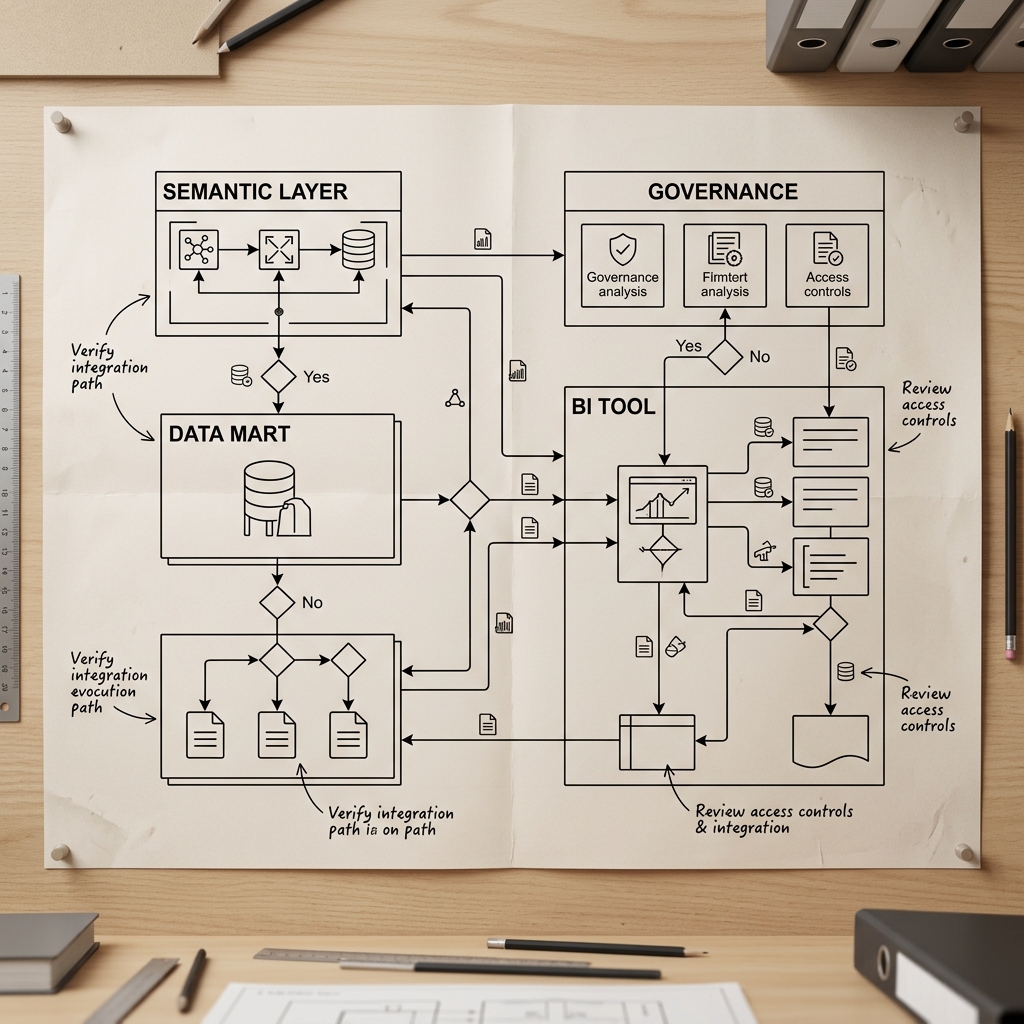
Deciding Between a Semantic Layer and a Data Mart
The right answer depends on your team's maturity, tooling, and how volatile your metric definitions are. Neither option is universally superior, but the tradeoffs heavily favour semantic layers in fast-moving SaaS environments where definitions evolve alongside the product. The following framework helps data engineers and product teams make a grounded decision rather than defaulting to whatever pattern they inherited.
A Practical Comparison Framework
This table distils the key trade-offs that should drive your architectural decision. Evaluate each criterion based on your team's current reality, not its aspirational state.
Criterion | Semantic Layer | Data Mart |
|---|---|---|
Metric consistency | Single definition consumed everywhere | Definitions embedded per mart, prone to drift |
Query performance | Depends on caching layer; can match marts with proper config | Pre-aggregated, fast out of the box |
Flexibility for new use cases | Add dimensions or metrics without rebuilds | Requires new tables, ETL changes, and validation |
Governance and auditability | Centralized lineage and access control | Fragmented, requires external catalog tooling |
Tooling requirements | Needs compatible BI tools and API consumers | Works with any SQL-capable tool |
Team skill requirement | Requires understanding of semantic modeling | Familiar SQL/ETL patterns, lower learning curve |
Best fit | High metric velocity, multi-tool environments | Stable reporting domains with low change frequency |
The most important takeaway from this comparison is that semantic layers win on governance and flexibility, while data marts win on simplicity and raw performance. For SaaS teams running consistent SaaS metrics across multiple tools, the governance advantage alone often justifies the migration. Teams with a single BI tool and stable reporting needs may find data marts perfectly adequate, and adding a semantic layer would introduce unnecessary complexity.
When to Choose a Semantic Layer
Choose a semantic layer when your team defines metrics in more than two places, when product changes regularly invalidate existing metric logic, or when multiple warehouse-native tools need the same definitions. The semantic layer dbt integration has matured significantly, allowing teams already invested in dbt to extend their transformation layer into a full metrics layer without adopting an entirely new platform. This is particularly valuable for SaaS startups scaling from seed to Series B, where the data team is small but the number of metric consumers grows rapidly.
A semantic layer for data engineers also shifts the operational model. Instead of fielding tickets to build new data marts for every department request, the team defines dimensions and measures once, and consumers explore data within governed boundaries. This reduces engineering toil and improves data quality dimensions across the organization. TrackRaptor's coverage of semantic layer implementation patterns shows that teams adopting this approach typically reduce metric discrepancy tickets by 40-60% within the first quarter.

Evaluating Semantic Layer Tools for SaaS Contexts
Choosing to adopt a semantic layer is only half the decision. The tool you select determines whether you get the governance and flexibility benefits in practice or just in theory. SaaS teams should evaluate platforms across three axes: integration depth with existing warehouse and transformation tooling, governance controls (access policies, lineage, versioning), and the developer experience for defining and maintaining metrics.
Cube vs Looker vs dbt Semantic Layer
Its caching engine (pre-aggregation layer) can match data mart performance when properly configured, which makes it a strong choice for high-query-volume environments. Cube's documentation describes pre-aggregations as a caching technique that can reduce query response times from seconds to milliseconds for frequently run queries.
Looker's semantic layer (LookML) is tightly coupled to Looker as a BI platform. If your organization is fully committed to Looker, LookML provides robust semantic layer architecture tools with strong governance features. The tradeoff is vendor lock-in: your metric definitions are only accessible through Looker's ecosystem. The dbt semantic layer (MetricFlow) integrates directly into the transformation layer, which appeals to teams that want to define metrics alongside their models. It is the most natural fit for dbt-heavy shops, though its ecosystem of consuming tools is still expanding. For a deeper breakdown, best semantic layer tools coverage from TrackRaptor provides vendor-specific evaluations.
What SaaS Teams Should Prioritize
Beyond feature comparisons, the selection criteria that matter most for SaaS teams are API-first access (so product engineering can embed metrics natively), Git-based version control for metric definitions (so changes are reviewable and auditable), and support for multi-tenant data isolation if you are building customer-facing analytics. Teams focused on event taxonomy governance should also verify that the semantic layer can enforce naming conventions and dimension hierarchies that align with your existing tracking standards. The best semantic layer platforms treat governance as a first-class feature rather than an afterthought, which is critical for SaaS teams operating under SOC 2 or similar compliance frameworks.
Conclusion
The semantic layer vs data mart decision is ultimately about where you want business logic to live and how much flexibility you need as your product and team evolve. For most SaaS teams working with modern data stacks, a semantic layer provides the consistency, governance, and adaptability that data marts struggle to deliver at scale. Data marts remain useful for stable, performance-sensitive reporting domains, but they should be the exception rather than the architectural default. Start by auditing how many places your critical metrics are defined today, and let the answer guide whether centralization through a semantic layer is a nice-to-have or an urgent need.
Frequently Asked Questions (FAQs)
What is a semantic layer?
A semantic layer is an abstraction that sits between your data warehouse and consuming tools, defining business metrics, dimensions, and relationships in a single governed location so every downstream application computes metrics identically.
How does a semantic layer work with dbt?
The dbt semantic layer uses Metric Flow to let teams define metrics directly within their dbt project, which are then queryable through supported BI tools and APIs without duplicating logic outside the transformation layer.
Can a semantic layer replace a data mart?
A semantic layer can replace most data marts by providing the same consistent metric access without pre-aggregated tables, though data marts may still be warranted for extremely high-volume, latency-sensitive reporting use cases.
Is a semantic layer the same as a metrics layer?
A metrics layer is a subset of a semantic layer focused specifically on metric definitions, while a semantic layer encompasses broader concerns including dimension hierarchies, access controls, relationships, and governance policies.
Why do you need a semantic layer?
You need a semantic layer when metric definitions are scattered across multiple tools and SQL queries, causing inconsistent reporting that erodes trust in data across product, finance, and growth teams.
What problems does a semantic layer solve?
A semantic layer solves metric drift, duplicated business logic, ungoverned ad-hoc queries, and the engineering overhead of maintaining separate data marts for each department or use case.
What is the best semantic layer tool for SaaS teams?
Cube is the strongest general-purpose option for SaaS teams needing API-first access and multi-tool consumption, while the dbt semantic layer is the best fit for teams already deeply invested in dbt as their transformation framework.