
Warehouse-Native CDP vs Traditional CDP: Which Wins for SaaS?
Warehouse-native CDP or traditional CDP — which is right for your SaaS stack? We break down architecture, identity resolution, and reverse ETL trade-offs to help you decide.
Introduction
The customer data platform SaaS teams choose in 2026 is no longer just a tooling decision; it is an architectural bet that shapes identity resolution, data freshness, pipeline costs, and downstream activation quality for years. Traditional CDPs like Segment and mParticle built their value on bundling ingestion, identity graphs, and audience activation into a single managed service. Warehouse-native CDPs flip that model by treating your existing Snowflake, BigQuery, or Databricks instance as the single source of truth and layering activation directly on top of it. For SaaS teams running mature data stacks, the choice between these two models determines whether first-party data tracking remains clean, affordable, and governed, or quietly fragments under duplicated pipelines and vendor lock-in.
Key Takeaway: Warehouse-native CDPs give SaaS teams with mature data stacks better control over identity resolution, lower long-term costs, and zero data duplication, while traditional CDPs remain the faster path for teams without dedicated data engineering resources.

Architectural Differences That Actually Matter
The marketing copy for both models sounds similar: unified customer profiles, real-time activation, cross-channel orchestration. The architectural reality underneath is fundamentally different, and that difference drives every downstream consequence for SaaS tracking infrastructure architecture.
How Traditional CDPs Handle Data Flow
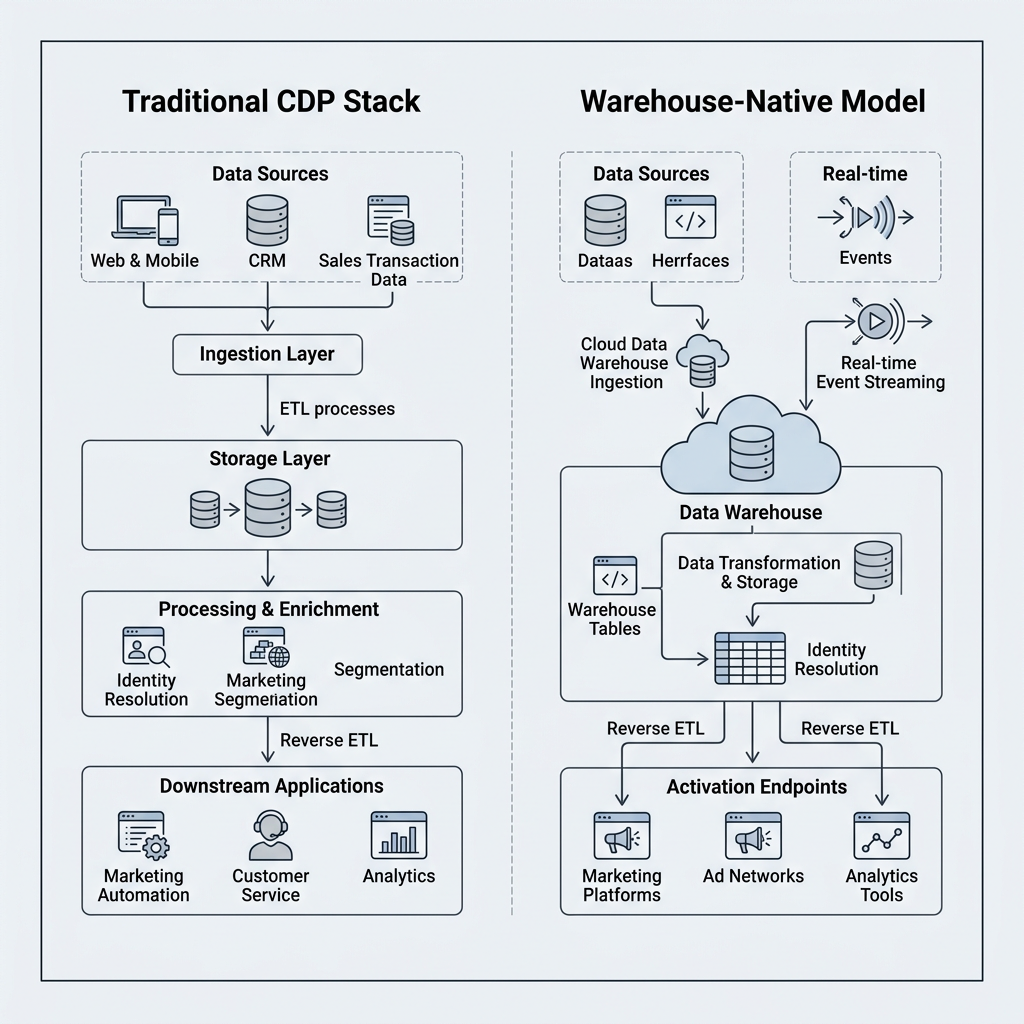
Traditional CDPs operate as self-contained platforms. They ingest raw event streams from your product, website, and mobile apps, then copy that data into their own managed storage layer where identity stitching, profile unification, and audience segmentation happen. This creates a parallel data silo that sits outside your warehouse. The implications are worth spelling out:
Data duplication: Every event lands in both your warehouse and the CDP's storage, doubling pipeline volume and inflating costs
Identity graph opacity: The CDP's identity resolution logic runs inside a black box you cannot inspect, test, or override
Sync lag: Audiences and profiles must be synced back to your warehouse via exports or connectors, introducing latency and version drift
Vendor lock-in: Custom transformations, audience definitions, and identity rules live inside the CDP, making migration expensive
How Warehouse-Native CDPs Restructure the Stack
Warehouse-native CDPs eliminate the copied storage layer entirely. Instead of ingesting and storing your data, they connect directly to your existing warehouse and run identity resolution, segmentation, and activation queries against the data where it already lives. Tools like Census, Hightouch, and RudderStack Profiles operate this way, treating the warehouse as the CDP engine. This means your dbt models, your event taxonomy, and your data quality checks remain the authoritative layer. There is no second copy of truth competing with your first-party data infrastructure.

Trade-Offs, Use Cases, and the Decision Framework
Neither architecture wins universally. The right choice depends on your team's data engineering maturity, your real-time activation requirements, and where you are willing to accept trade-offs on flexibility versus speed of deployment.
When Each Model Wins
Traditional CDPs still make sense for early-stage SaaS companies that lack dedicated data engineering headcount and need a turnkey solution for event collection and basic audience activation. If your team does not yet have a governed warehouse with clean event taxonomy, a traditional CDP provides guardrails. The setup cost is lower, the time-to-value is faster, and you get managed identity resolution out of the box.
Warehouse-native CDPs win decisively for SaaS teams that already run a structured data stack with dbt transformations, real-time event streaming pipelines, and a defined event taxonomy. When your warehouse is already the source of truth, adding a traditional CDP on top creates friction, not value. The reverse ETL tracking model lets you push unified profiles and computed audiences directly from your warehouse into marketing tools, CRMs, and product surfaces without maintaining a parallel identity system. Teams using this approach through platforms like warehouse-connected activation layers report significantly lower pipeline maintenance overhead.
The following table breaks down the most decision-relevant differences between the two approaches:
Dimension | Traditional CDP | Warehouse-Native CDP |
|---|---|---|
Data storage | Managed by CDP vendor | Your warehouse (Snowflake, BigQuery, Databricks) |
Identity resolution | Black-box, vendor-managed graph | SQL-based, auditable, customizable |
Setup time | Days to weeks | Weeks to months (requires mature stack) |
Pipeline duplication | High: data copied into CDP storage | None: queries run on existing data |
Real-time activation | Built-in, sub-second latency | Near-real-time, depends on warehouse refresh |
Vendor lock-in | High: logic lives in CDP | Low: logic lives in your warehouse |
Cost at scale | Grows with event volume (MTU pricing) | Grows with warehouse compute (predictable) |
GDPR compliance | Dependent on vendor's data handling | Data stays in your governed environment |
The most important row in that table is cost at scale. Traditional CDP pricing models charge per monthly tracked user, which means your costs spike precisely when your product succeeds. Warehouse-native CDPs tie activation costs to compute, which SaaS data teams already budget for and optimize.
Identity Resolution and Data Quality: The Hidden Battleground
Identity resolution is where the architectural difference creates the widest quality gap. Traditional CDPs resolve identity using proprietary probabilistic and deterministic matching algorithms that you cannot inspect. When merge logic produces incorrect unifications (and it will), debugging requires opening support tickets rather than running a SQL query. For SaaS products where accurate user identity directly impacts consistent SaaS metrics, this opacity is a liability.
Warehouse-native identity resolution puts the logic in your hands. You define merge keys, write the stitching queries in dbt, and test them against known edge cases. When anonymous events need to be reconciled with authenticated profiles, you control the waterfall logic. This matters especially for SaaS products with freemium-to-paid conversion funnels, where a single user can generate events across multiple anonymous sessions before signing up. Tracking data loss prevention depends on getting this identity chain right, and warehouse-native models give you the tooling to verify it.
TrackRaptor has covered extensively how fragmented identity graphs degrade multi-touch attribution models and inflate reported churn. The pattern is consistent: teams that cannot audit their identity logic cannot trust their downstream metrics.
Conclusion
For SaaS teams with a mature warehouse and data engineering capacity, warehouse-native CDPs are the stronger architectural choice. They eliminate data duplication, make identity resolution auditable, align costs with compute rather than event volume, and keep governance within your existing stack. Traditional CDPs still serve teams that need turnkey activation before they have built a governed data layer. The question is not which model is universally better, but which one matches the stage and sophistication of your tracking architecture. Evaluate against your own stack maturity, and let [TrackRaptor](https://trackraptor.vercel.app/) serve as your research baseline for the deeper architectural topics referenced throughout this piece.
Frequently Asked Questions (FAQs)
What is a warehouse-native CDP?
A warehouse-native CDP runs identity resolution, segmentation, and audience activation directly on your existing data warehouse (Snowflake, BigQuery, or Databricks) instead of copying data into a separate managed platform.
How does reverse ETL work?
Reverse ETL syncs transformed data from your warehouse back into operational tools like CRMs, marketing platforms, and product interfaces by running scheduled or triggered queries and pushing the results downstream.
How to resolve user identity across anonymous and authenticated sessions?
Define deterministic merge keys (email, user ID) in your identity graph and build a stitching waterfall that retroactively attaches anonymous event histories to authenticated profiles upon login or signup.
How to prevent tracking data loss in a SaaS product?
Implement server-side event collection, validate events against a governed taxonomy before ingestion, and run automated data quality checks in your warehouse to catch schema drift or missing properties.
What SaaS tracking tools are GDPR-compliant in Europe?
European SaaS tracking solutions that store data within EU boundaries, such as Plausible, Matomo, and warehouse-native CDPs running on EU-hosted Snowflake or BigQuery instances, are the most straightforward options for GDPR-compliant tracking.
How does a warehouse-native CDP compare to a traditional CDP?
A warehouse-native CDP queries data in place and gives you full control over identity logic and governance, while a traditional CDP copies data into its own storage and manages identity resolution through proprietary algorithms you cannot directly audit.
Which is better, Segment vs custom tracking for SaaS?
Segment offers faster initial setup and managed infrastructure, but custom tracking built on your warehouse with reverse ETL gives mature teams more flexibility, lower costs at scale, and full ownership of the identity graph.